D Chord on Guitar: Open, D/A and Barre Shapes
D major is the bright, ringing chord at the heart of many folk, country and pop songs. Choose a shape to see the fingering and the note on each string.
Fingers for the open D chord
- Index finger on the 2nd fret of the G string (3rd string).
- Ring finger on the 3rd fret of the B string (2nd string).
- Middle finger on the 2nd fret of the high e string (1st string).
- Strum from the open D string. Leave out the low E and A strings.
The three fingers form a small triangle. Because only four strings are played, aim the strum at the thinner strings; letting the thumb reach over the top of the neck to touch the low E string is one way some players keep it quiet.
D, F♯ and A
D major is D (root), F♯ (major third) and A (fifth). From the 4th string up, the open shape plays D–A–D–F♯; the F♯ on the high e string is what gives the chord its bright top.
Other D shapes
D/A: adding the open A string
Strumming the open A string as well gives D with A in the bass. It is still a D major chord and sounds fuller; it works well when the next chord is A or G.
Barre chords at the 5th and 10th frets
The A-shape barre at the 5th fret and the E-shape barre at the 10th fret both play D major with no open strings, so they can be muted for rhythm playing or moved to other keys.
The key of D major
| Degree | I | ii | iii | IV | V | vi | vii° |
|---|---|---|---|---|---|---|---|
| Chord | D | Em | F♯m | G | A | Bm | C♯° |
D major has two sharps, F♯ and C♯. Its main progression D–G–A uses the three major chords; D–A–Bm–G is another very common pattern. Each key’s chords appear on the circle of fifths.
Getting a clean D
- High e string muted: the ring finger is leaning on it. Bring the ring finger up onto its tip.
- Buzz on the B string: the ring finger is too far from the 3rd fret wire.
- Boomy sound: the A or low E string is being hit; start the strum at the D string.
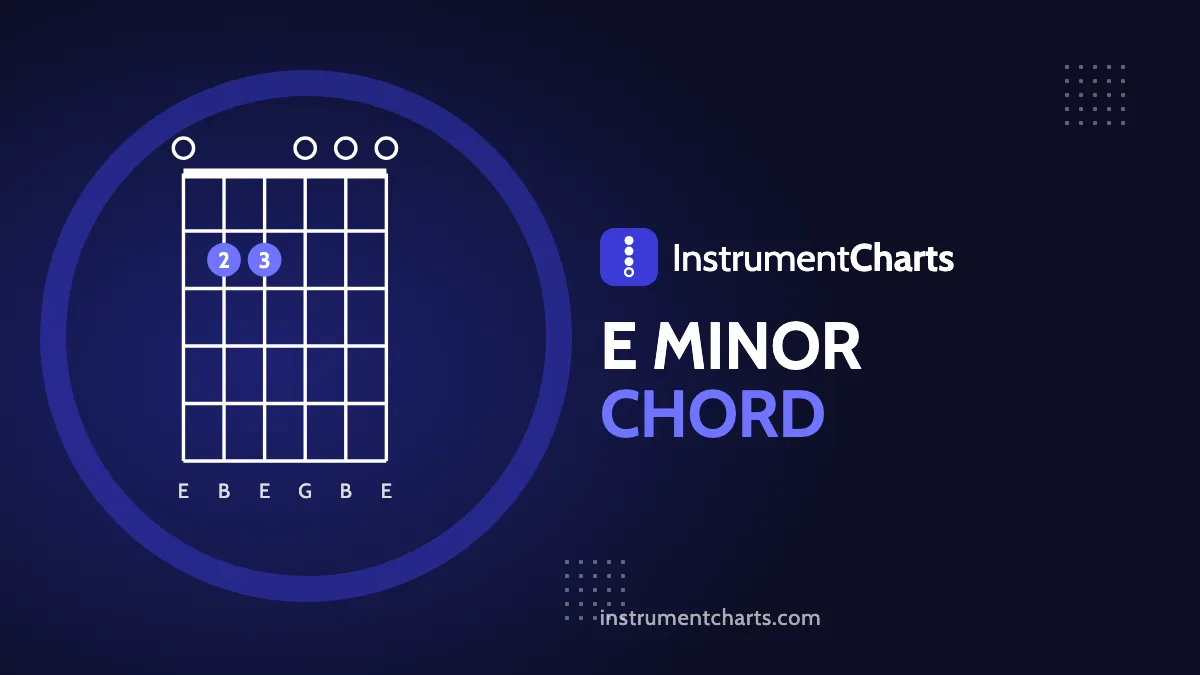
D is often played with G and A. For a minor chord to go with it, try E minor.
Frequently asked questions
How many strings do you strum on a D chord?
Four: D, G, B and high e. The low E and A strings are left out, or the A string can be added to make D/A.
Why does my D chord sound thin?
Only four strings ring, so D is naturally lighter than G or E. Adding the open A string (D/A) gives a fuller sound.
What is the D/F♯ chord?
D with F♯ in the bass, usually played by adding the 2nd fret of the low E string, often with the thumb. It is a common passing chord between G and Em.
Which barre shape plays D?
The A-shape barre at the 5th fret (x57775) or the E-shape barre at the 10th fret.
Sources
- Fender guitar chord lessons
- Major chord: root, major third, perfect fifth (Wikipedia)
- Guitar chord (Wikipedia)
- Standard tuning E–A–D–G–B–E (Wikipedia)
- Every shape on this page is checked by script: the note on each played string is calculated from standard tuning and must match the chord’s notes exactly.