A Chord on Guitar: Fingerings and Easy Shapes
The A major chord is a bright open chord that appears in rock, blues, pop and folk. Pick a shape to see how to finger it and which note each string plays.
Fingering the open A chord
- Put your index finger on the 2nd fret of the D string (4th string).
- Put your middle finger on the 2nd fret of the G string (3rd string).
- Put your ring finger on the 2nd fret of the B string (2nd string).
- Play the open A string and the open high e string, and leave out the low E string.
All three fingers share the 2nd fret, so they have to squeeze in side by side. Angle them slightly so each fingertip sits just behind the fret wire.
Why A major has a C♯
A major chord is built from a root, the note four semitones above it (the major third) and the note seven semitones above it (the perfect fifth). Four semitones above A is C♯, not C, so A major contains A, C♯ and E. On the guitar, the C♯ is the note your ring finger plays on the B string. The open shape plays A–E–A–C♯–E from the 5th string to the 1st.
A chord variations
Alternate fingering (2–1–3)
Swapping the index and middle fingers, so the middle finger plays the D string and the index finger the G string, gives some players more room. It is the same notes with a different hand position, so use whichever feels comfortable.
A with one finger
You can press the D, G and B strings at the 2nd fret with one finger laid flat. It frees the other fingers and makes fast changes easier, but the high e string is easily muted; let it go silent if it doesn’t ring.
A barre chord at the 5th fret
The E-shape barre chord at the 5th fret plays A on all six strings. It is the same shape as the G barre chord two frets higher, which shows how barre chords move up and down the neck.
Chords that share A major’s key
| Degree | I | ii | iii | IV | V | vi | vii° |
|---|---|---|---|---|---|---|---|
| Chord | A | Bm | C♯m | D | E | F♯m | G♯° |
A major has three sharps (F♯, C♯ and G♯). The progressions A–D–E and A–E–F♯m–D use chords from this table. See all keys on the circle of fifths.
When the A chord won’t fit under your fingers
- Fingers don’t fit: try the 2–1–3 fingering or the one-finger version.
- High e string muted: the ring finger is touching it. Pull the ring finger slightly toward the fret and arch it.
- Muddy sound: make sure the low E string isn’t played.
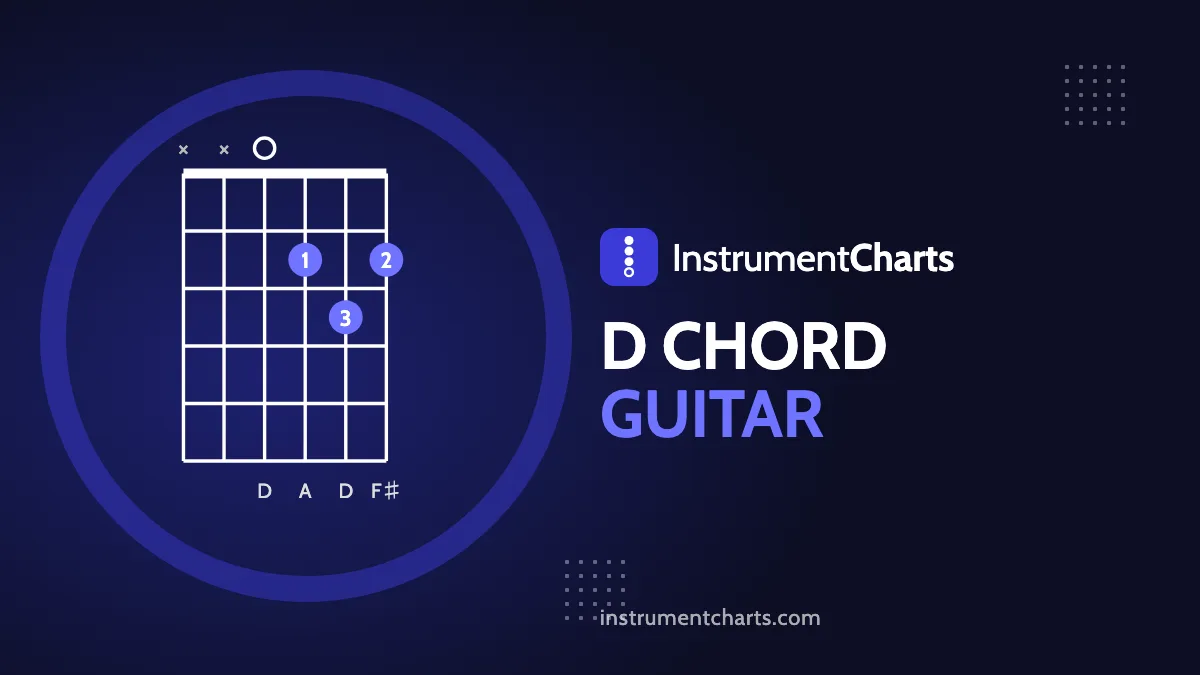
Using a capo? The G chord shape with a capo on the 2nd fret sounds as A. Also learn the C chord, and in the key of A the D and E chords.
Frequently asked questions
Why is the high e string muted on my A chord?
Usually the underside of the ring finger is touching it. Pull the ring finger slightly toward the fret wire and arch it, or switch to the 2–1–3 fingering, which leaves more room.
How do I fit three fingers on the 2nd fret?
Angle the fingers diagonally so they line up one slightly behind the other, or use the 2–1–3 fingering. Laying one finger across all three strings also works.
How can I change between A and D faster?
Practise the change slowly, lifting and placing all three fingers together as one shape, then gradually speed up. Strumming only on the beat where the new chord starts gives your hand time to move.
What is the difference between A and Am?
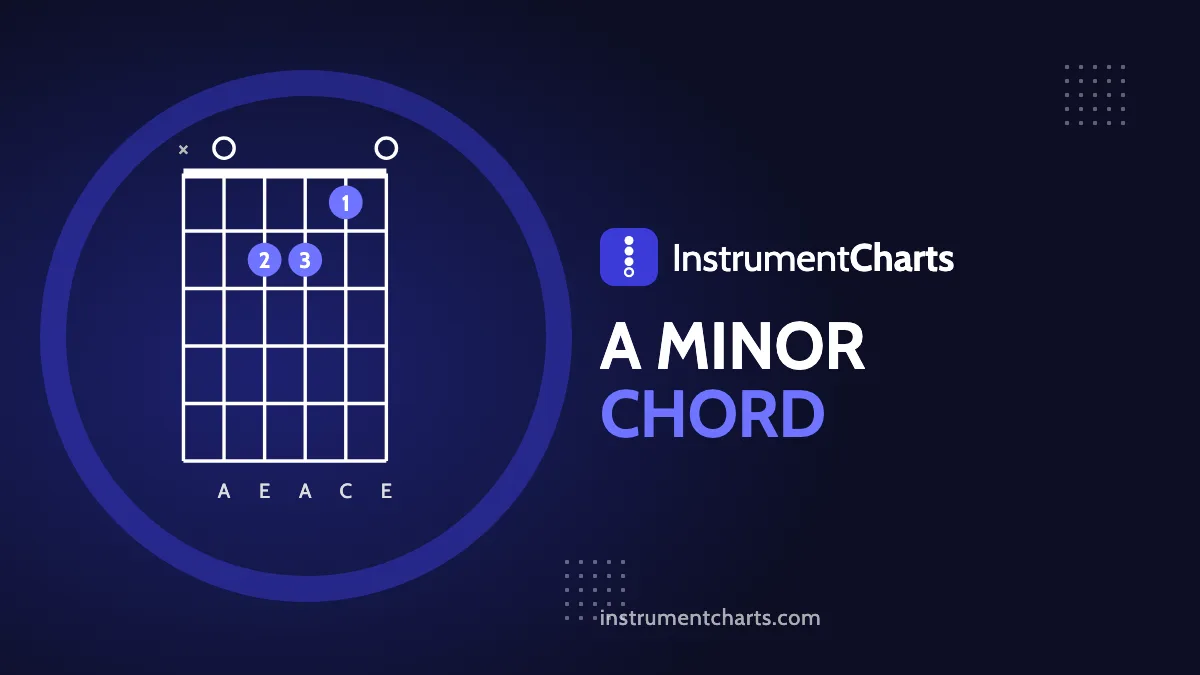
A minor lowers the third from C♯ to C. On the guitar the open Am chord moves the B-string note from the 2nd fret down to the 1st fret, changing the shape to x02210.
Sources
- Fender, How to Play the A Chord on Guitar — standard fingerings compared shape by shape.
- Guitar chord (Wikipedia)
- Standard tuning E–A–D–G–B–E (Wikipedia)
- Major chord: root, major third, perfect fifth (Wikipedia)
- Every shape on this page is checked by script: the notes on each fretted and open string are calculated from standard tuning and must match the chord’s notes exactly.