Circle of Fifths Chart: Keys, Scales and Chords
The circle of fifths arranges the 12 major keys and their relative minor keys in a circle, so you can read key signatures, find related keys and work out the chords of any key at a glance. Tap or click a key on the circle below to see its key signature, scale and chords.
The outer ring shows major keys and the inner ring shows their relative minors. Keys at the bottom of the circle have two names because they sound the same on a piano (for example F♯ major and G♭ major).
How the circle of fifths works
Start at C major at the top, which has no sharps or flats. Each step clockwise moves up a perfect fifth (seven semitones): C to G, G to D, D to A, and so on. Each of those steps adds one sharp to the key signature. Going counterclockwise moves up a perfect fourth instead (C to F, F to B♭), and each step adds one flat. After 12 steps you arrive back at C, which is why the keys form a closed circle.
Reading key signatures from the circle
The number of sharps or flats in a key equals how many steps it sits from C. G is one step clockwise, so it has one sharp; E♭ is three steps counterclockwise, so it has three flats.
The order of sharps and flats
Sharps are always added in the same order: F♯ C♯ G♯ D♯ A♯ E♯ B♯. A key with three sharps uses the first three: F♯, C♯ and G♯. Flats are added in the reverse order: B♭ E♭ A♭ D♭ G♭ C♭ F♭. A common memory aid for sharps is “Father Charles Goes Down And Ends Battle”; read it backwards for flats.
Two shortcuts help with key names. In a sharp key, the tonic is one half step above the last sharp (last sharp C♯ → D major). In a flat key with two or more flats, the tonic is the second-to-last flat (B♭ E♭ A♭ → E♭ major).
Relative minor keys
Every major key shares its key signature with one minor key, called its relative minor. The relative minor starts on the sixth note of the major scale, which is three semitones (a minor third) below the major tonic. C major and A minor both have no sharps or flats; G major and E minor both have one sharp.
Using the circle of fifths for chords
In any major key, the three major chords are the tonic (I) and its two neighbors on the circle: the subdominant (IV) one step counterclockwise and the dominant (V) one step clockwise. The three minor chords (ii, iii and vi) are the relative minors of those same three keys. In C major that gives C, F and G as major chords, and Dm, Em and Am as minor chords. The seventh chord of the scale (vii°) is diminished.
This is why progressions such as I–IV–V and I–vi–IV–V sound so natural: they use chords that sit right next to each other on the circle. Moving around the circle counterclockwise (for example Em–Am–Dm–G–C) is also a very common way to lead back to the tonic.
All 12 major keys at a glance
| Major key | Relative minor | Key signature | Chords (I ii iii IV V vi vii°) |
|---|---|---|---|
| C | Am | — | C Dm Em F G Am B° |
| G | Em | 1 ♯ | G Am Bm C D Em F♯° |
| D | Bm | 2 ♯ | D Em F♯m G A Bm C♯° |
| A | F♯m | 3 ♯ | A Bm C♯m D E F♯m G♯° |
| E | C♯m | 4 ♯ | E F♯m G♯m A B C♯m D♯° |
| B / C♭ | G♯m | 5 ♯ | B C♯m D♯m E F♯ G♯m A♯° |
| F♯ / G♭ | D♯m | 6 ♯ | F♯ G♯m A♯m B C♯ D♯m E♯° |
| D♭ / C♯ | B♭m | 5 ♭ | D♭ E♭m Fm G♭ A♭ B♭m C° |
| A♭ | Fm | 4 ♭ | A♭ B♭m Cm D♭ E♭ Fm G° |
| E♭ | Cm | 3 ♭ | E♭ Fm Gm A♭ B♭ Cm D° |
| B♭ | Gm | 2 ♭ | B♭ Cm Dm E♭ F Gm A° |
| F | Dm | 1 ♭ | F Gm Am B♭ C Dm E° |
Enharmonic keys at the bottom of the circle
Three positions have two possible names. B major (5 sharps) can also be written as C♭ major (7 flats). F♯ major (6 sharps) is the same as G♭ major (6 flats). D♭ major (5 flats) can also be written as C♯ major (7 sharps). Composers usually choose the spelling with fewer accidentals, so you will see D♭ more often than C♯ and B more often than C♭.
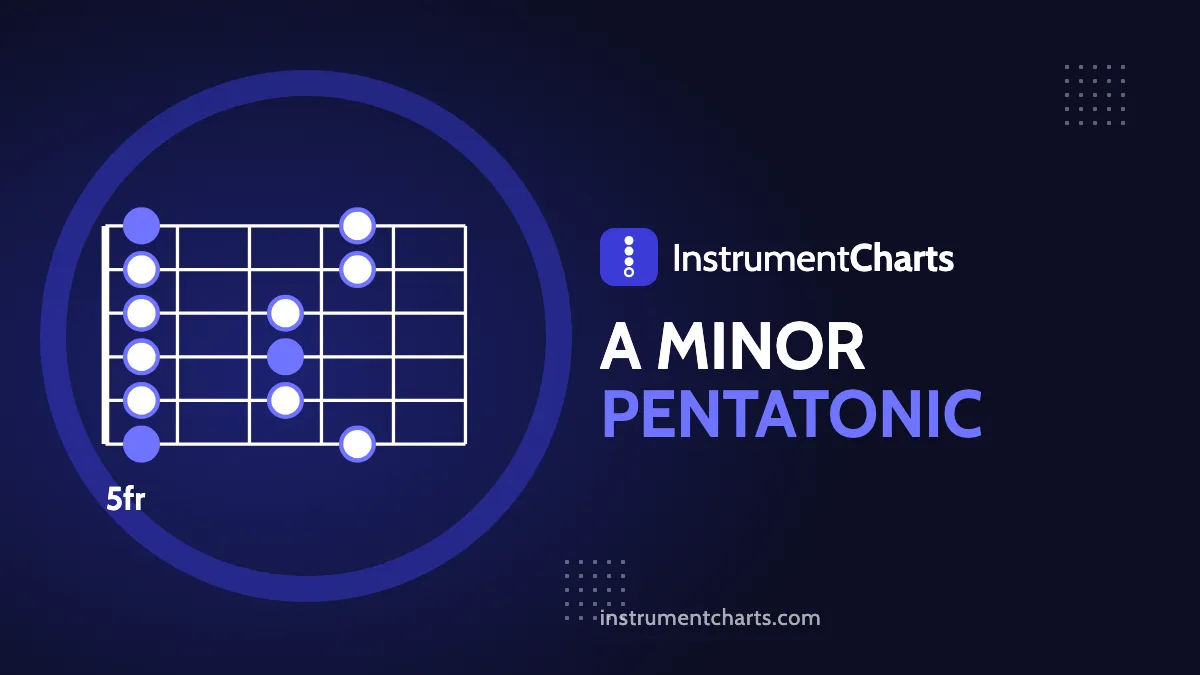
Clarinet, trumpet and saxophone players read music in transposed keys. Our clarinet fingering chart explains written and sounding pitch on a B♭ clarinet. For soloing in A minor, the relative minor of C, see the A minor pentatonic scale.
Frequently asked questions
Why is it called the circle of fifths?
Each key on the circle is a perfect fifth above the key before it when you move clockwise. After twelve fifths you come back to the starting note, so the keys form a circle.
How many sharps are in E major?
E major has four sharps: F♯, C♯, G♯ and D♯. It sits four steps clockwise from C on the circle, which matches its four sharps.
What is the relative minor of G major?
E minor. It shares G major’s key signature of one sharp (F♯) and starts on the sixth note of the G major scale.
Is the circle of fifths the same as the circle of fourths?
It is the same circle read in the other direction. Clockwise each step is up a fifth; counterclockwise each step is up a fourth.
Sources
- Open Music Theory (open textbook), chapters on key signatures and the circle of fifths.
- musictheory.net lessons “Key Signatures” and “Circle of Fifths”.
- Scales, key signatures and chords on this page are generated by script from interval rules and checked automatically (seven letter names per scale, accidentals matching each key signature, neighbors a perfect fifth apart).